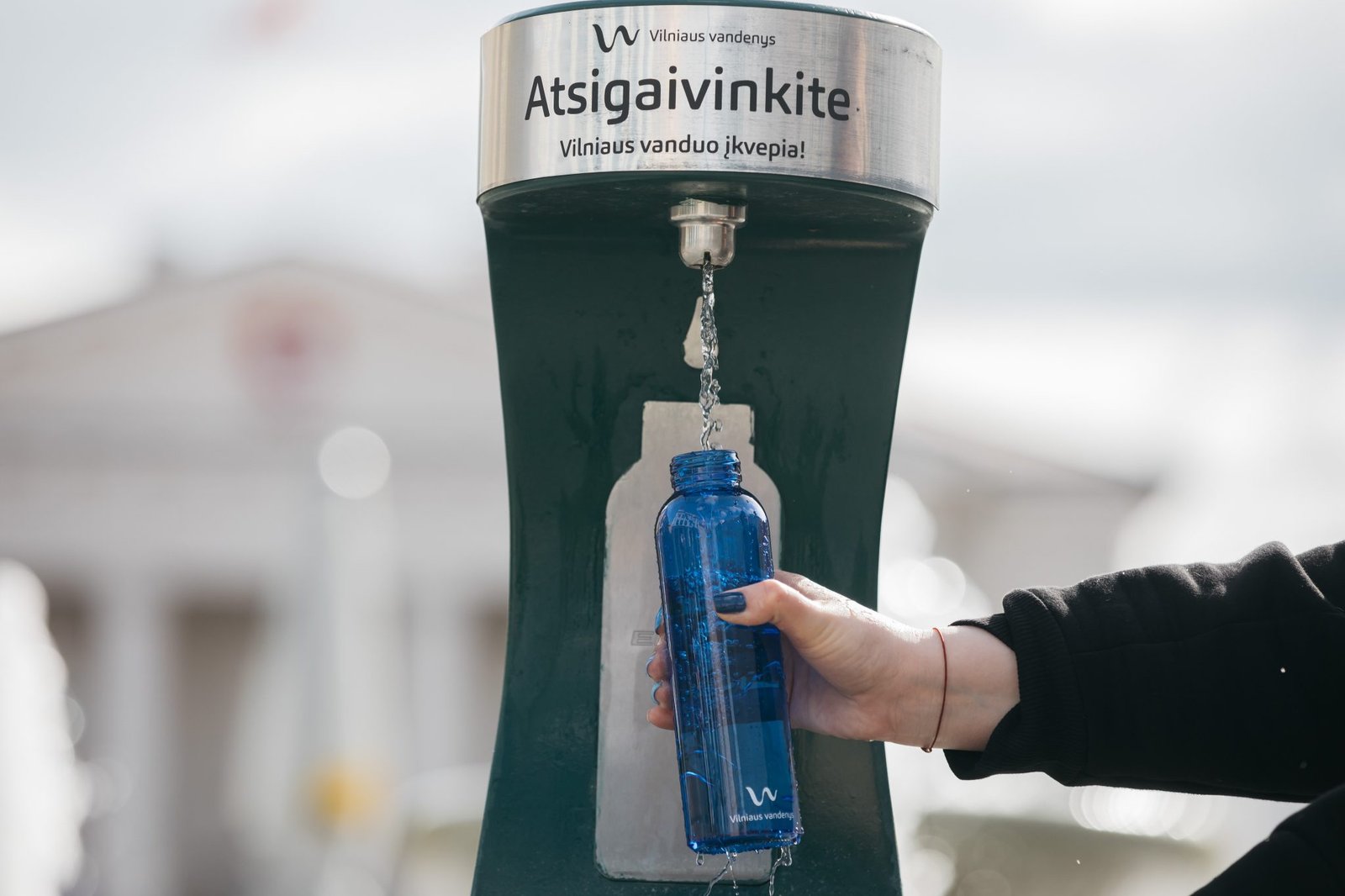
Vilniaus vandenys has calculated that Vilnius residents drank more than 6 million glasses of water from outdoor drinking fountains this year
According to Vilniaus vandenys, residents and visitors to the capital drank one and a half times more water from outdoor drinking fountains this year than last year. Throughout the outdoor drinking fountain season, which began in the first warm days of April, 1.25 million litres, or 6.2 million glasses, of water have already been drunk. This is a record for the capital, which Vilniaus vandenys plans to improve together with Vilnius residents in 2026.
By comparison, in 2024, city residents filled their drinking fountains in the city with 4.2 million glasses or 853,000 litres of water. In 2025, twice as much water was drunk, despite the fact that this summer was the coolest since 2017.
“Just six years ago, we installed the first five outdoor drinking fountains in the city centre – it was a kind of experiment. Today, I can confidently say that this decision has paid off. As we expand the network of outdoor drinking fountains, we are seeing them become more popular and the habits of Vilnius residents change – more and more people are replacing traditional bottled water with sustainable drinking fountains and refilling them at water stations around the city. This is one example of how a small urban infrastructure solution can have a huge impact on shaping the daily habits of residents. More clean and fresh tap water means less water from plastic bottles and a more sustainable environment,” says Saulius Savickas, the head of Vilniaus vandenys.
According to him, the majority of residents in the capital choose tap water: 66% of Vilnius residents drink only tap water or choose it more often than water purchased in shops. Another 21% of respondents said they drink both centrally supplied water and bottled water equally often. It is also important to note that almost a half of Vilnius residents take a water bottle with them when they leave home.
Data available to Vilniaus vandenys shows that in 2025, Vilnius residents most often used water fountains installed in city parks and sports grounds.
“The most notable was the drinking fountain installed this year at Bernardinai Garden tennis courts, where almost 300,000 litres or approximately 1.5 million glasses of water were consumed. This means that we successfully predicted where Vilnius residents needed them most. In Vingis Park, where many Vilnius residents exercise and spend their free time, residents filled their bottles with the equivalent of about 735 thousand glasses of water from the drinking fountains. The public drinking fountains installed near the White Bridge and Ozas Park were also extremely popular,” says S. Savickas reviewing the results of the season.
The water fountains have also become popular among schoolchildren. Some of the most frequently used fountains were those installed next to Abraomas Kulvietis Gymnasium in Fabijoniškės, Trakai Vokė Gymnasium, Antakalnis Gymnasium, and Ąžuolynas Progymnasium in Lazdynai.
This year, 50 public drinking fountains connected directly to the city’s water supply were available throughout Vilnius, from the Old Town to more remote areas. They are located in areas with the highest foot traffic: parks, squares, schools, sports fields, bicycle and pedestrian paths, as well as residential areas.
In addition, Vilniaus vandenys has installed over 70 drinking fountains in hospitals, clinics and cultural institutions, and more than 100 schools have drinking water fountains.
The water supplied to Vilnius residents in outdoor drinking fountains is extracted from deep wells, ranging from 40 to 245 metres in depth, so it is clean, pure, fresh and pleasant tasting – just like the water that flows from the tap at home.
The outdoor drinking fountain season in the capital usually begins in April and lasts until November. The locations of all public drinking fountains can be found on an interactive map online.